

Advertorial
Advertorial
Cleanliness of materials
The terms cleanliness and purity of materials require a more detailed definition. Since the materials, whether as molded parts or films, are present in their surface, the term cleanliness may be appropriate here, since cleanliness of materials can refer to the structure, i.e. also the internal structure of an overall body.
Contamination of materials can have several causes and can take many forms. Particulate contamination will be considered, as well as filmic contamination. The former will be present as single points and will be irregular and spaced. Filmic soiling, on the other hand, covers the surface completely or partially and, if clean, can also be described as pure, which would have to be subject to a respective definition, e.g. surface tension / surface energy. However, they cannot refer to the internal structure of the workpiece, which can at best only be described by the cleanliness.
Two complementary testing methods
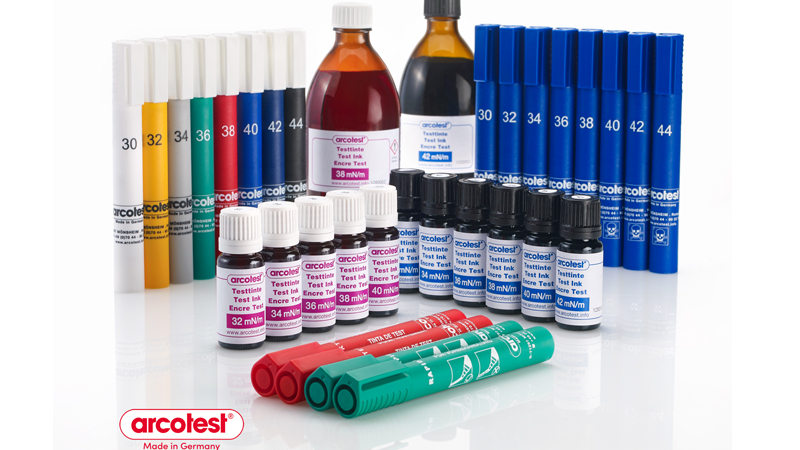
Since it is the surfaces that are subject to further processing, the states of cleanliness must also be defined, which is generally possible with the concept of surface tension. The processing concerns, for example, printing, painting and bonding. The procedures for this are, as a simple solution, testing of the surfaces with test inks and contact angle measurement. The former is easy to handle and therefore practical, since ink can be easily applied to the test surfaces in the production processes. The latter requires an equipment-related effort. It can show the components of the surface tension in polar and disperse separately. The test ink test shows only the sum of the two values, which is usually sufficient for an evaluation of the surfaces. Neither method can be used in a non-contact or continuous manner. The latter means that in manufacturing processes, as is the case with films in particular, the measurements can only be carried out at rest, i.e. not on running webs. In exceptional cases, a measurement could only be made at very low speed. The terms cleanliness and purity can be used alternatively, with cleanliness always being applicable to surfaces only. However, it is better not to use them together, because this can lead to irritation.
Pretreatment with increased surface tension
The term pretreatment traditionally refers to the cleaning of surfaces by mechanical means, mainly washing with or without solvents. For several decades, pretreatment has also been used with physical treatment by means of corona, plasma and flame treatment, in which the surfaces are modified by electrical action in such a way that their polar fractions are greatly increased, which increases the surface tension and thus significantly improves adhesion. For example, plastics made of polyolefins, whose natural values of surface tension are 30 mN/m, can be relatively easily brought to values above 45 mN/m, which provides very good adhesion values for printing and bonding, painting. These values can by no means be achieved by the original methods of cleaning, whereby it must be seen that for a useful pretreatment with the physical methods, a precleaning of the mechanical way is mostly necessary. This is especially true for metal surfaces that are contaminated, for example, with oils used in the manufacture of the foils or molded parts.
(Kopie 6)
arcotest GmbH
Rotweg 25 / P.O. Box 1142
71297 Moensheim
Tel: +49 7044 90 22 70 , Fax: - 69
www.arcotest.info