

Clean lightweight components for electric vehicles
Since an e-vehicle lacks the engine as a drive element and thus also an important stabilizing factor, the front structure in the engine compartment had to be completely redesigned and reinforced to ensure the safety of passengers and the integrity of the battery in the event of a collision. New elements made of lightweight materials, such as aluminum and hybrid materials, now increase the vehicle's rigidity and strength.
To ensure that these newly used elements can be bonded and welded properly, thorough aqueous cleaning is essential beforehand. The components must be free of grease and stains. However, all other hollow sections used for reasons of weight and noise reduction must also be thoroughly cleaned inside and out. Managing Director and owner of BvL Oberflächentechnik GmbH, Bernhard Sievering, reports on the versatile requirements for cleaning in e-mobility: "We are well positioned in the e-mobility sector. We clean these 'new parts' in continuous or batch operation. Other components for electric vehicles are also cleaned efficiently and reliably with BvL systems. These include, for example, battery housings and various elements of drive technology and power electronics."
Cleaning long body parts
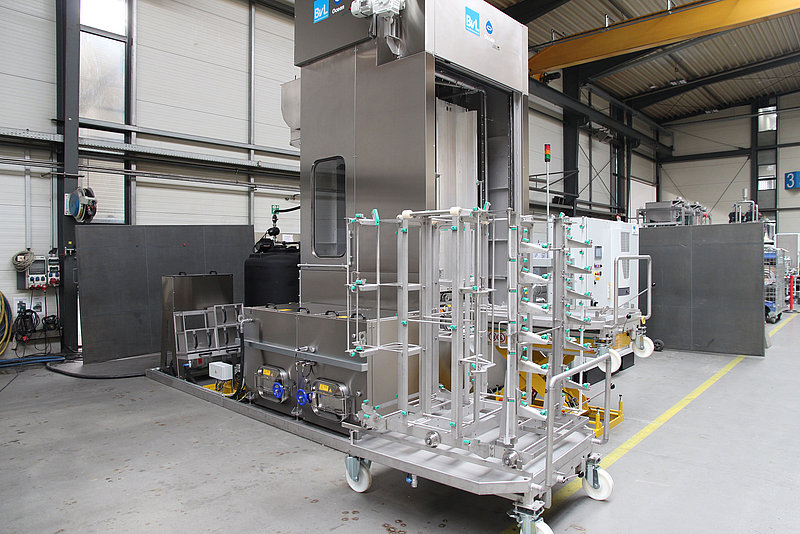
For cleaning particularly long body parts - as in the case of extruded profiles, for example - BvL's Ocean 1600 RW 2-Tank cleaning system with a special useful height is suitable. The BvL engineers have designed and manufactured a special workpiece carrier on which the body parts, which can be up to 2,200 millimeters long, are fixed vertically and positioned precisely on the areas to be cleaned. A lifting table is used to raise the workpiece carrier from floor level to machine height. After cleaning by spraying, rinsing is carried out with deionized water to reduce mineral and cleaner residues before painting.
Uniform drying over the entire useful height
Recirculating air drying in the form of a vertical blow-off nozzle covering the entire useful height dries the parts. The rotation of the turntable with the workpiece carrier past the drying nozzle ensures thorough drying on all sides. The surface tension for paintability of ≥38 mN/m is safely achieved. Paint adhesion is guaranteed as long as the system parameters remain stable. Depending on the batch, sensors such as BvL Libelle Fluid Control or Libelle Cleaner Control are used to evaluate and monitor the system parameters such as conductivity, pressure and temperature. The measured values are stored on an integrated data logger. The Libelle products thus ensure a high level of quality control and process monitoring. The BvL Libelle Oil Control Solo measures the part surface to ensure the paintability of the parts after cleaning. The mobile device can be used to quickly decide whether the component is suitable for the subsequent process.
BvL Oberflächentechnik GmbH
www.bvl-group.de