

Clean into the operating room
Wege, um empfindliche Rotguss-Komponenten medizintauglich zu reinigen
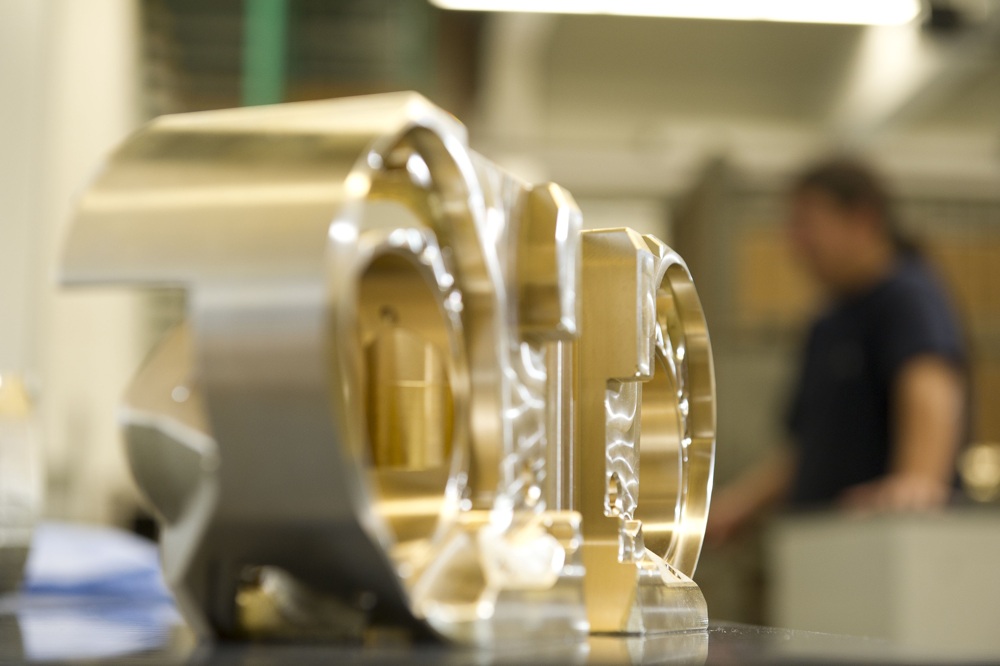
In order to make the cleaning of red castings as economical as possible, Eckerle Industrie GmbH relies on a spray flooding machine. Thanks to vector kinematics, the selected model reliably meets the high cleanliness requirements of medical technology.
The special machine manufacturer Eckerle has been producing complex assemblies and system components for various industries for 50 years. For example, the CNC specialist manufactures three assemblies for the electrical operation of operating tables for the medical technology company Maquet, which is part of the Getinge Group. "Modern operating tables are high-performance medical devices with many technical refinements that ensure safe and easy patient positioning. All components must meet the highest quality standards in terms of materials, technology and workmanship," explains Production Manager Reiner Schäfer. The surfaces of the assemblies must not show any contamination from machining and must leave the cleaning process absolutely dry. This is the only way to guarantee corrosion-free storage and shipping as well as trouble-free further processing at the customer.
Until now, the components at Eckerle were washed on a simple cleaning system, then manually dried, stored, and cleaned and dried again shortly before shipment. "This procedure had become uneconomical and would not have kept up with the increasing demands of our customers for much longer," says Ferdinand Ernst, team leader at Eckerle. With a new machine, these work steps were now to be combined and made more efficient.
The manufacturing process at Eckerle is quite complex. Before the gunmetal components reach the final cleaning stage, they pass through a multi-stage production chain consisting of turning-milling, deburring and polishing. After all manufacturing steps have been completed, the surfaces of the components show machining residues such as cooling emulsion, polishing dust and chips.
The cleaning solution had to ensure that all regions of the component were free of particles, because even the smallest amount of contamination can jeopardize the assembly requirements at Maquet and compromise the necessary smooth running of the motors installed in them. The numerous bores and undercuts of the components as well as the now very small particle sizes of the contaminants make cleaning difficult.
Challenges of gunmetal as a material
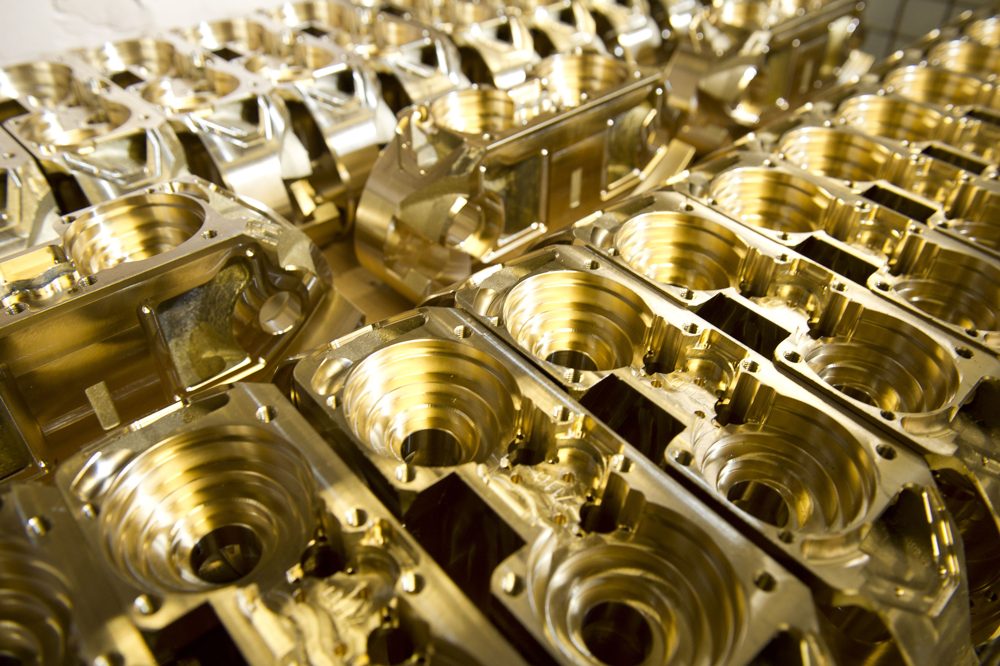
Gunmetal is a rather soft material that is prone to staining and the development of verdigris due to its high copper content. For the cleaning process, this means: It should be gentle and have a drying process that ensures components with surfaces free of stains and moisture at reduced temperatures.
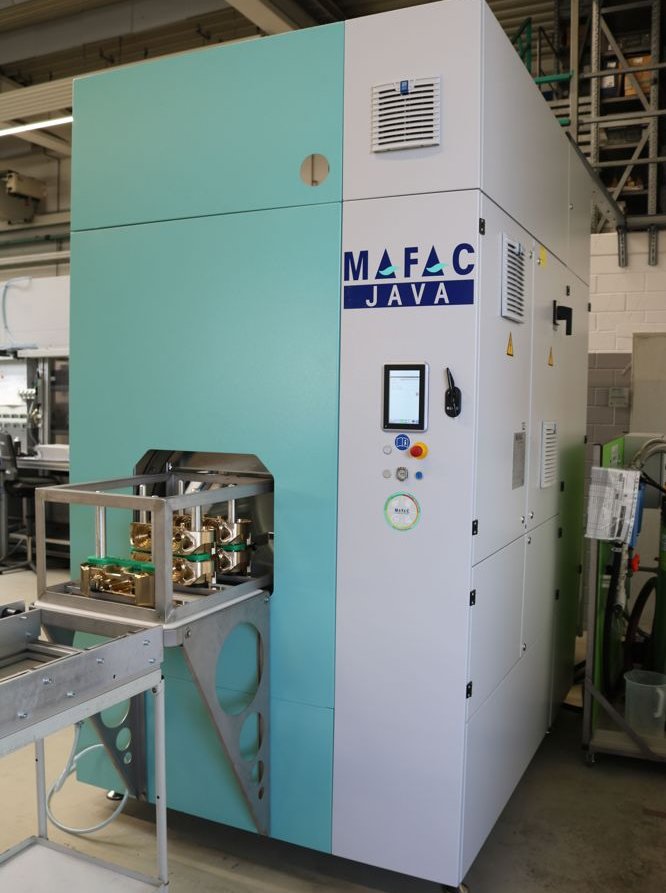
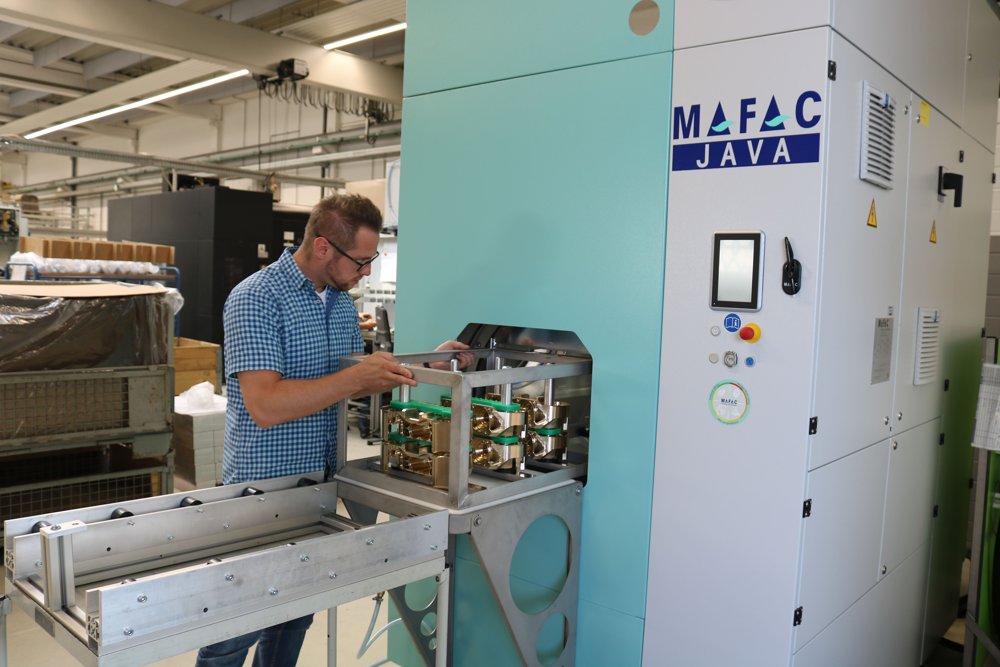
After extensive consultations, Eckerle's technicians decided on Mafac's Java spray flood machine with two-tank technology. In combination with the technology options of vector kinematics and vacuum drying, it achieves high cleanliness values on the surfaces - gentle on the material within a short time and reliable for all component regions. "We are dealing here with a further development of the patented process technology of counter-rotation or co-rotation of the spraying and basket pick-up system," explains Sascha Klos, sales representative at Mafac. During cleaning and drying, strong turbulence in the cleaning chamber ensures greater and more uniform impact on the components. The strong flow effect occurs because the nozzle tube performs both a rotating and a pivoting motion. The swiveling movement takes place around its own axis by 35 degrees to each side. Synchronously to this, the basket pick-up system rotates at an optimally adapted speed. The ingenious interplay of nozzle tube and basket movement in synchronous and counter-rotation ensures that even regions that are difficult to reach, such as blind holes, are better reached by the cleaning medium. Due to the greater mechanical component, vector kinematics leads to the desired cleaning result in a shorter time. The improved flow effect during the cleaning and drying phase finally convinced the two technicians to invest in the new Mafac vector kinematics: "With this process, we not only gain in effectiveness. In the future, we will also be able to react much more flexibly to changes in the parts spectrum or to growing cleanliness requirements," says Reiner Schäfer.
Two-stage cleaning process with bypass filtration
The cleaning process consists of several steps: In the first step, the parts, which measure around 500 x 200 x 200 millimeters, are fed in small batches as set goods to the cleaning chamber, where they undergo a treatment process lasting around eleven minutes with the sequence cleaning - rinsing - vacuum drying. During the cleaning phase from tank one, to which 2.5 percent mild cleaning medium has been added, a spraying and flooding process alternate. Flooding is cyclical, i.e., two-thirds of the water from the cleaning chamber is drained and flooded again. This process is repeated several times. At the same time, the nozzle and basket pick-up system perform a counter-rotating motion. To protect the components in the basket, it moves in a rocking motion.
A temperature value of 60 degrees Celsius is maintained throughout the wet phase. Before the process switches to the rinsing phase, an overlift process, during which the components are blown off, prevents particle and media carryover. After this, rinsing is carried out from tank two with deionized water. This is particularly important because of the high copper content in gunmetal and the associated risk of oxidation. This means that the conductivity in the water must remain low, which is why the rinsing bath is also equipped with a rinsing bath maintenance module. This contains an activated carbon unit and two ion exchange units. In addition, it is permanently filtered with a resin cartridge in the bypass.
"We could already see that such an additional component was recommended and would eventually prove its worth during the test cleanings in the Mafac pilot plant," explains Ferdinand Ernst. There it also became clear that the cleaner must be matched to the cooling lubricant so that the components leave the cleaning chamber without any gray haze. The technicians selected the mildly alkaline cleaner Hakapur 56-170 from Kluthe, which produces high cleanliness values downstream of the water-miscible cooling emulsion of the Hakuform range, also from Kluthe.
Vacuum drying - an important step towards completion.
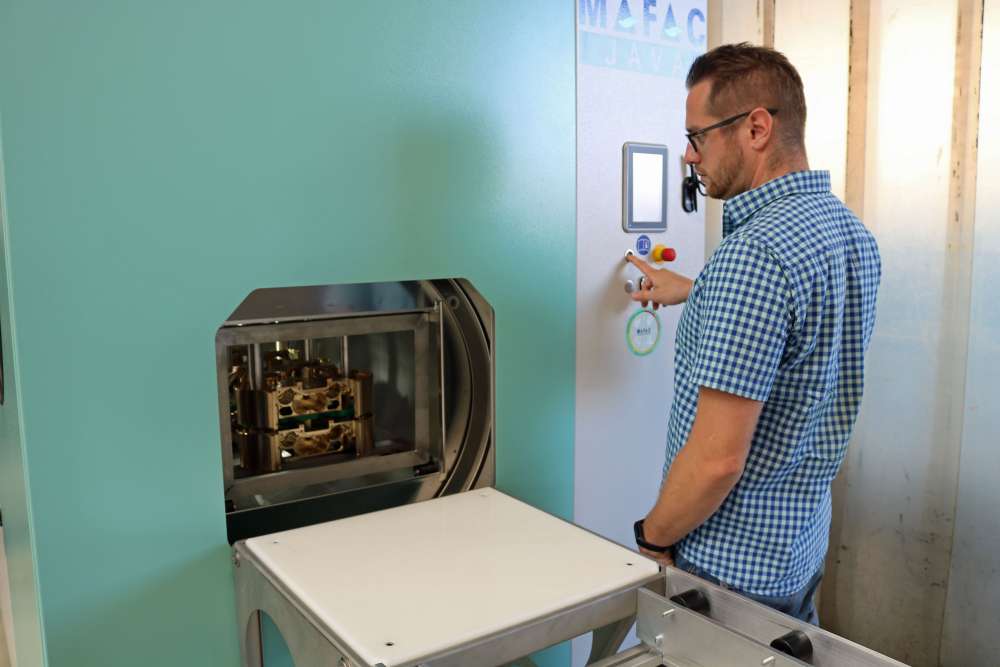
To ensure that the components leave the machine without residual moisture, the Mafac Java is equipped with a warm air pulse blowing system as well as a vacuum drying system. Via the pulse blowing system, warm air of 40 degrees Celsius is first supplied to the treatment chamber. Based on the basket-nozzle rotation, the rotational movement and impulsive impingement ensure efficient heat and mass transfer. This results in a homogeneous heat distribution. In addition, the water droplets are broken up into many small units by the pulses of compressed air. The increased surface area in this way means that the water can dry more quickly. With the subsequent vacuum drying, which is particularly suitable for heat-sensitive materials such as red brass, the material to be dried is subjected to a vacuum. This causes the water to evaporate at lower temperatures, as the boiling point of the water is reduced. Under this effect, the drying time is considerably reduced and the surfaces of the components are nevertheless absolutely dry and free of residues.
Competitive advantages through high quality level
Since the installation of the Mafac Java, positive effects in terms of economic efficiency and cleaning quality have become apparent. For Ferdinand Ernst and Reiner Schäfer, this is an important aspect in view of the increasing cost and time pressure in the future. "The demands of our customers in the medical sector, but also in all other sectors, are very high and will continue to increase in the future," Schäfer confirms the prevailing trend. "Since the manufactured parts are always custom-made products with high quality requirements, we want to raise our standards in special machine construction and position ourselves safely for the growing demands. The acquisition of the Mafac Java with the new vector kinematics was a significant step in this direction and should increase our USP value in the industry and create competitive advantages."
MAFAC - E. Schwarz GmbH & Co. KG
www.mafac.de