
acp: Automated snow blasting removes paint from noble control panels
Gentle and automated removal of paint flakes from elegant control panels for household appliances
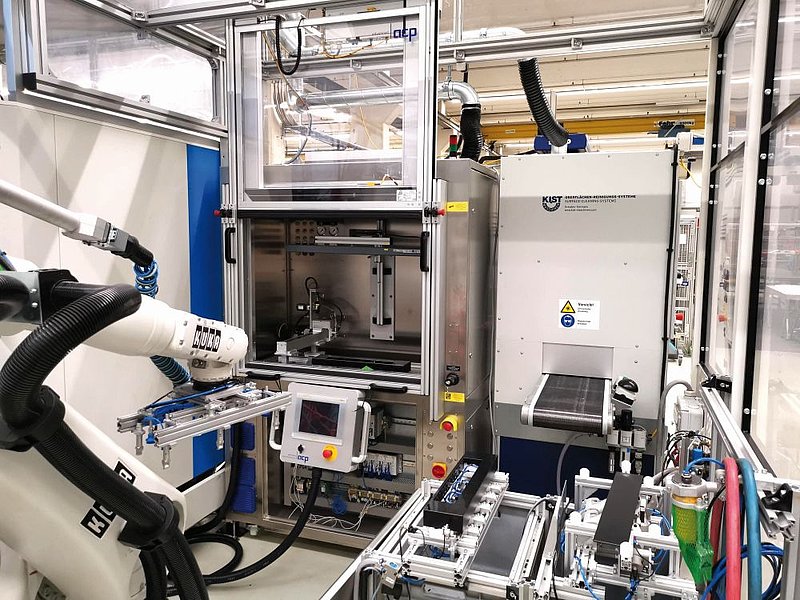
Using the in-mold decoration (IMD) process, a Swiss plastics processor manufactures, among other things, control panels for premium dishwashers. In order to efficiently remove paint residues, manual cleaning was replaced by an automated snow-jet process that gently removes paint flakes with contour precision.
Petroleum lamps, rechauds, ashtrays and metal pot lids were the first products manufactured by A. & J. Stöckli AG, founded in 1874. In recent decades, the family-owned company based in Netstal, Switzerland, and now managed by the fifth generation, has specialized in the use of injection molding and special processes for processing thermoplastics. Today, four business units manufacture household appliances for tabletop cooking, watering cans, logistics solutions such as containers and bottle crates, the Müllex waste separation system, which won a Red Dot Design Award, and customer-specific molded and visible parts and assemblies. The latter include design panels and control panels for premium household appliances such as dishwashers, which are manufactured using IMD technology. In the injection molding process, a white, black or chrome-colored coating is applied to the 55- or 60-centimeter-wide panels, giving them not only a high-quality appearance but also protecting them from scratches and chemical influences, for example from cleaning agents and food.
Replace manual cleaning
To achieve the requirements, a continuous film coated with UV coating is used, which is fed through the mold. During injection molding, the coating is transferred to the plastic component by pressure and temperature, creating a strong bond. After the mold has been run up, a jointed-arm robot removes the coated fascia, and the coating is automatically peeled off the carrier film in the process. "At the edges where the part is separated from the paint, some paint is pulled along. These so-called flakes impair the appearance and must therefore be removed," explains Rolf Lehmann, sales manager in the Custom Molded Parts business unit at Stöckli. Until now, this was done manually with fine knives by two employees.
To prevent the electrostatically charged paint flakes from settling on the components again, they were additionally blown off with ionized air. "However, manual cleaning repeatedly resulted in damage to the paint layer and thus in rejects. In addition, we received feedback from the customer that parts were still contaminated with flakes, which caused him additional cleaning effort," reports Rolf Lehmann. In the search for a more efficient and reliable cleaning solution, tests were carried out with dry ice, which is used in the company for cleaning the tools. The flakes could be removed with this, but the rugged ice particles left traces on the surfaces.
CO2 snow cleans effectively, gently and climate neutral
Through an internet research the sales manager became aware of the quattroClean technology of acp systems AG. The cleaning medium used in this dry process is liquid, climate-neutral carbon dioxide, which is a by-product of chemical processes and energy generation from biomass. It is fed through a wear-free two-substance ring nozzle and expands as it emerges to form fine snow particles. They are bundled by a separate compressed air jacket jet and accelerated to supersonic speed. When the minus 78.5 degrees Celsius cold, easily focusable cleaning jet hits the surface to be cleaned, the four mechanisms of action - thermal, mechanical, solvent and sublimation effects - ensure that particulate contamination and filmic chemical contamination are reliably removed.
"We found out more about this process and then carried out extensive cleaning trials in acp's technical center with panels coated in different colors. These parts were then inspected at our customer's premises and subjected to appropriate tests to check the resistance of the paint surfaces. After the customer confirmed the results, we made the purchase decision," recalls the sales manager. The thermal effect of the quattroClean process is particularly relevant for the damage-free removal of the paint flakes. It leads to embrittlement of the protruding paint residues, which are then sheared off with contour precision by the force of the snow jet. The non-abrasive snow particles and low hardness of the jet ensure that neither the appearance nor the functional properties of the coating are impaired.
Customized, integrated and automated cleaning
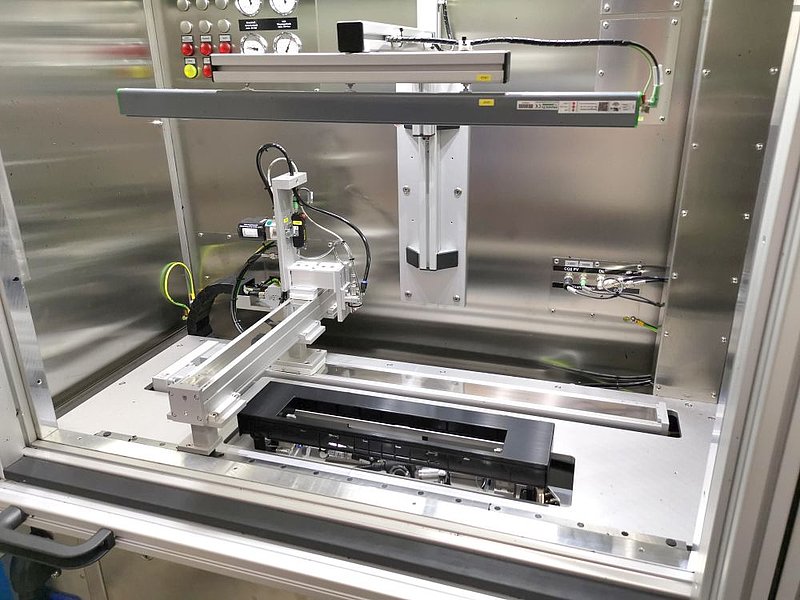
Based on Stöckli's requirements, acp designed an automated cleaning solution that was integrated into the production cell and integrated into the overall system in terms of control technology. The quattroClean system receives the information which orifice plate variant - 55 or 60 centimeters - is to be cleaned via the program selection of the injection molding machine. In addition, three speeds of 100, 150 and 200 mm per second are stored for cleaning.
The articulated-arm robot of the IMD system places the dishwasher panel in the cleaning station. After its lifting door is closed, the nozzle is guided along the edges to be cleaned by means of an X-Y axis system. Parallel to the cleaning process, the detached flakes are extracted together with the sublimated carbon dioxide and fed to a filter unit. Ionization units positioned above and below the component, some of which are equipped with turbo nozzles, prevent the removed flakes from becoming electrostatically charged and vagabonding back onto the component. After cleaning is complete, the robot removes the part and places it on the conveyor belt of the UV tunnel, where the coating is fully cured.
"For the complete process, i.e., removing the part from the injection molding machine, placing it in the cleaning station, cleaning it, removing it and placing it on the UV tunnel, we have a specification for the cycle time of one minute. This is adhered to at a speed of 100 mm/s, and if necessary we have reserves to clean faster," describes Rolf Lehmann. To ensure consistently high process and cleaning quality, both the jet consistency and the CO2 and compressed air supply as well as the jet duration are continuously monitored and all values are stored.
More economical to better cleaned parts
However, Rolf Lehmann and his customer are not only very satisfied with the cleaning result, but also with the cost-effectiveness of the automated cleaning. "We practically no longer need any personnel for cleaning, and rejects have decreased significantly. In addition, the quattroClean system is very cost-effective and the CO2 consumption per part is low. This has also reduced the manufacturing costs per orifice plate for our customer. He has therefore contributed to the investment for the cleaning solution and will achieve the return on investment in a relatively short time," reports Rolf Lehmann. For Stöckli, the investment will have paid for itself after around four years, given the current production volume of control panels for dishwashers. Due to the further increasing demands on the appearance of the design and operating elements, the company is currently examining whether the automated cleaning solution can be used for further of the total of 28 parts produced using the IMD process. "If this is the case, the return on investment will of course be achieved sooner," concludes Rolf Lehmann.
acp systems AG www.acp-systems.com
A. & J. Stöckli AG www.stockli.ch